Refraction By Lens
Q- Define law of refraction?
Ans- According to law of refraction (i) angle of incidence , angle of refraction & normal at the point of incidence all three lies in a plane . (ii) the ratio of sine of angle of incidence & sine of angle of refraction is always constant and known as refractive index of medium two with respect to medium one .
Q- Define power of lens. How it is related to focal length.
Ans- When focal length of lens taken in meter then reciprocal of focal length is known as power of lens. unit of power of lens is Dipotre.
Q-Focal length of a convex lens is negative . is it true?
Q- Power of two lenses are +5D and -2.5D. when both lenses are in contact what will be resultant focal length?
Ans- given P1= +5D , P2= -2.5D
Now P= P1+P2 = +5D-2.5D = +2.5D
so focal length f = 100/P = 100/+2.5 = +40 cm .
so resultant lens is convex lens.
Q-State the lens maker’s formula and write what each symbol means.
Ans-1/f = (n − 1)(1/R₁ − 1/R₂). Here f is the focal length, n is the refractive index of the lens material with respect to the surrounding medium, and R₁ and R₂ are the radii of curvature of the first and second surfaces, with signs taken by the Cartesian convention.
Q-A thin convex lens of focal length f is cut into two halves (a) along the principal axis and (b) perpendicular to the principal axis. What is the focal length of each half in the two cases?
Ans-(a) Cut along the principal axis: each half has the same radii of curvature, so the focal length stays f. The image is formed at the same place but is dimmer, since each half collects half the light.
(b) Cut perpendicular to the principal axis: each half is a plano-convex lens with R₂ = ∞. The original lens has 1/f = (n − 1)(2/R). Each half has 1/f′ = (n − 1)(1/R), which is half as much, so the focal length becomes 2f.
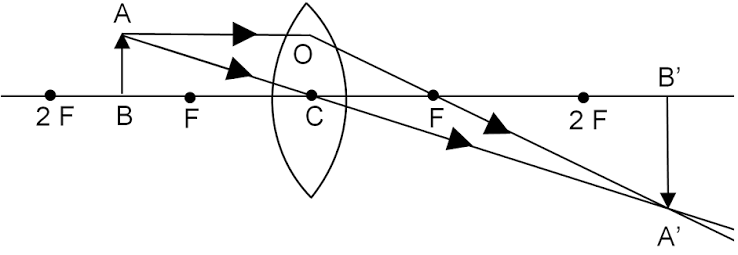
Q-Draw a ray diagram for the image formed by a convex lens when the object is placed between f and 2f. State the nature of the image.
Ans-Draw the principal axis with the convex lens at the centre and mark F and 2F on both sides. Place the object between F and 2F on the left. Draw one ray parallel to the axis that refracts through the focus on the right, and a second ray through the optical centre that goes straight. They meet beyond 2F on the right side. The image is real, inverted and magnified, and is formed beyond 2F.
Q-Why does a convex lens have no definite focal length for a distant object that is moved slowly towards it? Explain in terms of the lens formula what happens to v as u decreases from infinity to f.
Ans-From 1/v = 1/f + 1/u, when u is very large (object at infinity), 1/u ≈ 0 so v ≈ f. As the object comes closer, |u| decreases, 1/u becomes more negative in magnitude, and v increases. It becomes 2f when u = −2f, and v tends to infinity as u approaches −f. So the image distance is not fixed. Only for an object at infinity does the image form at the focus. (For u less than f in magnitude, the image becomes virtual.)
Q-Describe the nature, position and size of the image formed by a concave lens when the object is (a) at infinity and (b) at a finite distance in front of it.
Ans-(a) Object at infinity: the image forms at the focus F on the same side as the object. It is virtual, erect and extremely diminished (point-sized).
(b) Object at a finite distance: the image forms between the optical centre O and the focus F, on the same side as the object. It is virtual, erect and diminished. As the object moves closer, the image moves away from F towards the lens and grows slightly larger, but it never exceeds the object in size.
Q-Can a concave lens form a real image? Explain.
Ans-For a real object, a concave lens cannot form a real image. It only diverges the rays, so the refracted rays never meet and can only appear to meet when produced backwards, which gives a virtual image. A concave lens can form a real image only if the object is virtual, that is, if converging rays from another lens fall on it and are directed towards a point beyond the concave lens, nearer to it than its focus.
Q-Why is a concave lens used to correct myopia (short-sightedness)? Find the power of the lens needed by a person whose far point is 80 cm.
Ans-A myopic eye focuses distant objects in front of the retina, and its far point is closer than infinity. A concave lens diverges incoming parallel rays so that they appear to come from the person’s far point, which the eye can then focus.
The lens must form a virtual image of an object at infinity at the far point, so v = −80 cm, u = ∞, and f = v = −80 cm.
P = 1/f = 1/(−0.80) = −1.25 D.
The negative sign shows it is a diverging (concave) lens.