GAUSS THEOREM
Q-Define area vector.
A- In physics, particularly in electromagnetism, a planar area is treated as a vector quantity rather than just a scalar magnitude. The magnitude of the area vector represents the size of the surface, while its direction is perpendicular to the surface.
Q-Define electric flux. Write its SI unit.
A-Electric flux through a surface placed in an electric field is a measure of the total number of electric field lines passing normally through that surface.
Electric flux=E.dA
Q-What is the net flux through a closed surface that encloses no charge, or encloses an electric dipole? Explain.
A-The net flux is zero in both cases. For a surface with no charge inside, every field line that enters the surface also leaves it, so the inward and outward flux cancel. For a dipole, the total charge enclosed is +q − q = 0, so Φ = 0/ε₀ = 0, even though the field is not zero at points on the surface.
Q-Find the electric field at a distance of 0.5 m from a long straight wire carrying a uniform linear charge density of 2 μC/m.
A-E = λ/2πε₀r = 2k λ/r, with 2k = 2 × 9 × 10⁹ = 1.8 × 10¹⁰.
E = (1.8 × 10¹⁰ × 2 × 10⁻⁶)/0.5 = (3.6 × 10⁴)/0.5 = 7.2 × 10⁴ N/C, directed radially outward from the wire.
Q-What is a Gaussian surface? State the conditions for choosing a good one.
A-A Gaussian surface is an imaginary closed surface used to apply Gauss’s theorem. A good choice meets these conditions:
(i) it passes through the point where the field is to be found;
(ii) it matches the symmetry of the charge distribution (sphere, cylinder or pillbox);
(iii) over the surface (or its parts), E is either constant in magnitude and perpendicular to it, or parallel to it so that the flux through that part is zero;
(iv) it should not pass through any discrete charge.
Q-A point charge q is placed at one corner of a cube. Find the flux through the cube and through each of its faces.
A-Eight identical cubes placed around the corner would completely enclose the charge, so the flux through one cube is q/8ε₀.
The three faces that meet at the corner have the field lines running along them, so the flux through each is zero.
The other three faces share the flux equally, so each gets (q/8ε₀)/3 = q/24ε₀.
Q-Using Gauss’s theorem, find the electric field due to a uniformly charged thin spherical shell at points outside it and inside it.
A-For a shell of radius R with total charge q, use a concentric sphere of radius r as the Gaussian surface.
Inside (r < R): the enclosed charge is zero, so E = 0.
At the surface (r = R), E = q/4πε₀R².
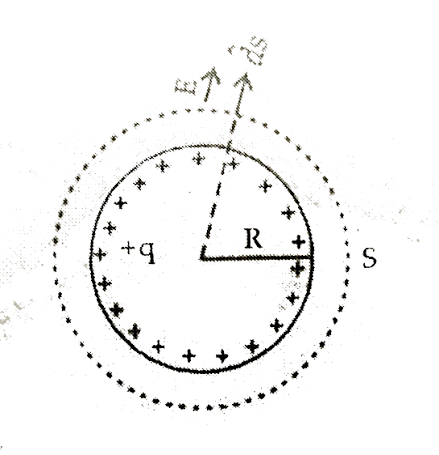
Outside (r > R): the enclosed charge is q, so E(4πr²) = q/ε₀ and E = q/4πε₀r². The shell acts like a point charge at its centre.
Q-State Gauss Theorem and prove it.
A- watch video solution. click below.

Q-Use Gauss’s Theorem to derive an expression for the electric field intensity due to an infinitely long, straight, uniformly charged wire.
A- Watch video solution. click below
Q-State the expression for the electric field intensity near a uniformly charged infinite plane sheet. Does it depend on distance?
A-Watch video solution. click below.